About
Whole roots of two perennial ryegrass genotypes of contrasting field nitrogen-use efficiency (Barhoney, high; Fagerlin, low) were sampled 4 h after nitrogen resupply at full or 25% less N, after one week of starvation, three clonal replicates each (12 libraries, 10x GEM-X snRNA-seq).
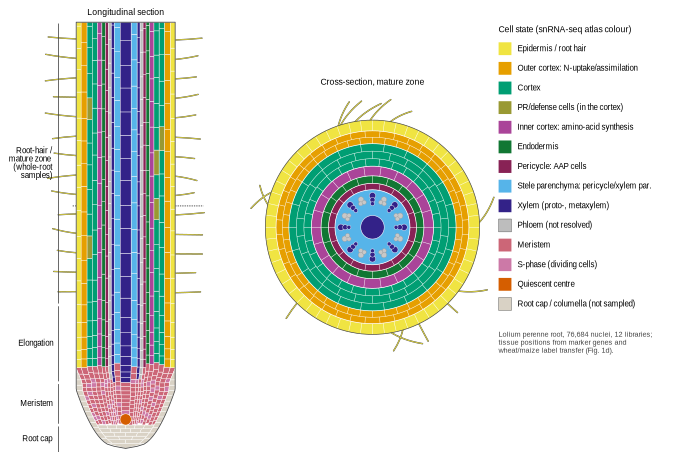
Nitrogen metabolism is partitioned into three cell states: high-affinity nitrate uptake (nine NRT2 transporters with their three NAR2 partners) in one cortical state, which shares the primary assimilation enzymes with its cortical neighbours; asparagine synthesis in a second cortical state; and amino-acid export (AAP and UMAMIT transporters) in the pericycle and stele parenchyma. Under reduced nitrogen the low-NUE genotype induces the uptake state; the high-NUE genotype does not, and expresses NRT2.3 at a higher baseline.
The schematic is drawn from general grass root anatomy (polyarch stele with a central metaxylem, multilayered cortex with an exodermis, closed meristem with columella and lateral root cap) and coloured by the cell states of this atlas; the number of cortical layers and xylem poles is schematic, and the radial placement of the two cortical nitrogen states is inferred from label transfer to the wheat and maize root atlases (half of the uptake-state nuclei map to wheat cortex, a quarter to pericycle and a sixth to epidermis), pending in situ hybridisation. Phloem and root cap were not resolved as separate states in whole-root nuclei.